
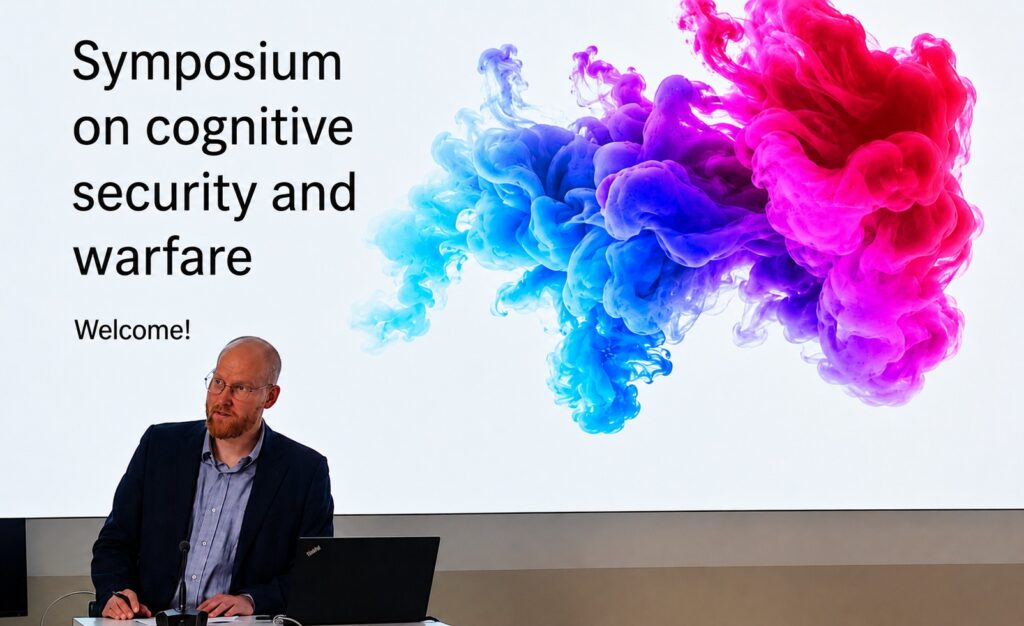
Perspectives on Cognitive Security: Reflections from the Symposium
As questions of security increasingly extend beyond physical infrastructure and traditional military domains, attention is also turning to the human mind. How are human cognition, perception, judgment, and meaning-making shaped, exploited, or protected in an era of persistent digital connectivity, information disorder, and rapidly advancing artificial intelligence? These were the central questions explored in the symposium Perspectives on Cognitive Security, organized by the Finnish Society for Cognitive Security as part of CogSci Days 2026 at the University of Helsinki.
The symposium brought together five invited speakers from different disciplines to examine cognitive security from complementary perspectives, ranging from knowledge quality and conceptual foundations to bounded rationality, military decision-making, and societal resilience. What emerged was a strong sense that cognitive security is not a narrow topic confined to defence discussions, but an interdisciplinary field that connects epistemology, design science, cognitive science, communication, public governance, information environments, and security studies. The event highlighted both the urgency of the topic and the value of bringing together researchers who approach it from different angles, while also showing that the field is beginning to develop a more precise conceptual and practical vocabulary of its own.
A central backdrop to the symposium was the growing recognition that contemporary conflict increasingly involves efforts to influence cognition itself. Cognitive warfare concerns the use of human cognition, information processing, and knowledge in conflicts where the battleground is the human mind. In this sense, cognitive security is not only about identifying threats, but also about understanding how societies, institutions, and individuals can maintain resilience under conditions of manipulation, uncertainty, and strategic influence operations. The rapid spread of generative AI, the intensity of digital media environments, and the increasingly blurred boundaries between peace and conflict all make these questions more pressing.
The first presentation, by Pertti Saariluoma of the University of Jyväskylä, approached cognitive security as a multidimensional phenomenon spanning domains such as finance, medicine, the environment, technology, and defence. But the presentation also added a more precise epistemic emphasis: what ultimately links these domains is the challenge of sustaining true, relevant, and practically useful knowledge in human and societal information processing. Saariluoma highlighted questions of information quality, truth, testing, self-correction, and the gap between belief and knowledge, suggesting that cognitive security depends not only on protecting minds from manipulation, but also on maintaining the conditions under which reliable knowledge can guide social discourse and innovation. This framing provided an important foundation for the symposium as a whole.
In the second talk, Aleksi Kivimaa of Tampere University addressed the conceptual relationship between information disorder and cognitive security by asking whether our current categories are adequate for the broader problem space of cognitive security at all. His presentation compared the frameworks of information disorder and cognitive warfare and argued that the familiar triad of disinformation, misinformation, and malinformation may leave important harmful processes analytically underdescribed. One especially striking point was his emphasis on harmful information that may be factually true yet still damaging in context, particularly such as highly emotive content that spreads and shapes cognition without fitting neatly into existing categories. Kivimaa’s intervention therefore underscored the need for sharper conceptual tools, not only to describe manipulation more accurately, but also to understand everyday cognitive resilience in media environments designed for attractivity, addictivity, and manipulativity. Audience questions after the talk brought key issues to the forefront: when concepts such as harm are deployed in these contexts, recognizing the normative and harm-for-whom aspects introduce tensions at the interface of applied science and application.
The third presentation, by Tuomo Kujala of the University of Jyväskylä, explored a foundational question in cognitive science: are people best understood primarily through their biases, or through forms of rational adaptation constrained by real-world limits? His bounded rationality approach challenged what he called a tendency toward “bias bias” in explanations of human behaviour. Drawing on research on misinformation, the talk suggested that believing and sharing misleading content is often better explained by inattention, lack of deliberation, insufficient knowledge, heuristics, and contextual constraints than by inherent irrationality alone. This has practical consequences for cognitive security. If explanations stop at bias, the actual motivations, bounds, and reasons behind undesirable behaviour remain hidden. Kujala’s presentation instead pointed toward a more analytical framework centred on goals, context, expected utility, and adaptive behaviour, while also ending on a notably constructive note: our cognitive bounds are not merely weaknesses, but also a source of flexibility, efficiency, and creativity.
The fourth talk, delivered by Mikko Salminen of the National Defence University, shifted attention to military environments and the cognitive processes involved in forming situational awareness and making decisions under demanding conditions. His presentation made clear that these processes can be supported — or degraded — at several levels. On the one hand, decision-making can be strengthened through the design of information presentation, the reduction of framing and order effects, transparency, and shared mental models in human–AI teams. On the other hand, organizational culture also matters: trust between units, avoidance of siloing and groupthink, psychological safety, and realistic workloads all shape how well decisions are made in practice. Salminen also connected these concerns to the narrative means of cognitive warfare, showing how distraction, demoralisation, deception, discrediting, and division can be used to target cognition in military contexts. The result was a concrete account of cognitive security in operational settings.
The final presentation, by Minttu Tikka of the Finnish Institute for Health and Welfare (THL), widened the lens to societal resilience and public communication. Grounding the discussion in crisis research and recent observations from Ukraine, Tikka framed societal mental resilience as a dynamic, multilevel, and constructed capability that spans preparedness, response, and recovery. Particularly important was her argument that resilience today must also include information resilience: the capacity to maintain reliable, appropriate, and useful flows of information in environments shaped by both intentional and unintentional misinformation. This, in turn, brought the communicative role of the public sector into sharper focus. Tikka showed that resilience is not merely a trait but a process that can be co-produced through communication before, during, and after crises – through trust-building, clear risk communication, shared situational awareness, information literacy, coordinated networks, preparedness campaigns, and active monitoring of the information environment. Her talk offered one of the clearest demonstrations of how cognitive security connects everyday communication, institutional trust, and societal preparedness.
Taken together, the presentations painted a picture of cognitive security as an emerging and deeply interdisciplinary field. Several shared themes stood out. First, questions of knowledge quality, truth, and conceptual clarity are central: without sound concepts and reliable epistemic foundations, both research and practice risk drifting into confusion. Second, cognitive security cannot be reduced to individual psychology alone, because it also depends on institutions, communication systems, organizational cultures, and societal structures. Third, understanding vulnerability requires more than diagnosing bias or manipulation after the fact; it also calls for more realistic models of human behaviour, attention, decision-making, and resilience in context. Finally, the symposium showed that cognitive science has a practical role to play in this field — not only as a source of theory, but as a basis for improving communication, preparedness, decision environments, and responses to strategic influence. These themes suggest that cognitive security is becoming a useful umbrella for conversations that cut across traditional disciplinary boundaries while also generating more concrete research agendas of its own.
The symposium also reflected a broader development in Finland: the emergence of a more visible network of researchers and practitioners working on cognitive security and cognitive defence. This is evident not only in events such as this symposium, but also in the recently published volume Perspectives on Cognitive Security: Proceedings of the Finnish Symposium on Cognitive Defence, edited by Henrikki Salo-Pöntinen, Antero Karvonen, and Pertti Saariluoma. The growing visibility of the topic in Finland is also reflected in the recent edited volume Kognitiivinen turvallisuus: Ihmismieli vaikuttamisen kohteena, edited by Teemu Häkkinen, Miriam Hautala, and Dominic Saari and published by Gaudeamus. Both Karvonen and Hautala are researchers in the AIDEMOC project.
Overall, Perspectives on Cognitive Security offered an insightful and timely contribution to an area of growing importance. It showed that the study of cognitive security requires dialogue between fields that do not always meet: cognitive science, military studies, communication research, public governance, and philosophy of knowledge, among others. Just as importantly, the symposium suggested that this dialogue is beginning to move beyond general concern toward more specific questions: how knowledge quality is sustained, how harmful information processes are conceptualised, how behaviour is explained, how decision environments are protected, and how resilience is communicatively built. If the symposium is any indication, this conversation is only beginning.
Antero Karvonen, member of the board, Finnish Society for Cognitive Security
Henrikki Salo-Pöntinen, member of the board, secretary, Finnish Society for Cognitive Security
